Prescription Borders: What the Law Actually Says About Importing Cheaper Medications
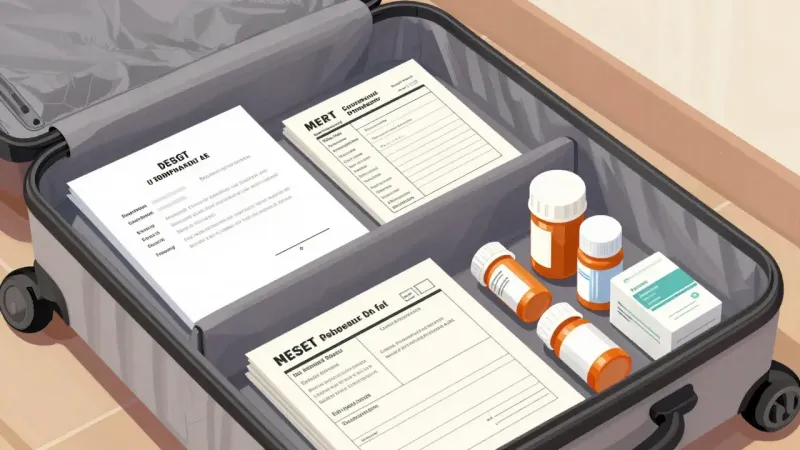
Photo: prescription medication packages and passport on desk crossing border concept, via drugswatcher.com
Insulin priced at ten times its Canadian equivalent. A $400 monthly prescription that costs $60 across the border. For a growing number of Americans, the arithmetic of drug pricing has become impossible to ignore—and it has pushed a quiet, widespread practice into the open: importing prescription medications from Canada and other countries, despite rules that technically prohibit it.
The Rule That Isn't Quite a Rule
Here is the uncomfortable truth at the center of this debate: under the Federal Food, Drug, and Cosmetic Act, importing prescription drugs from outside the United States is generally illegal. Full stop. But in practice, the FDA exercises what it calls "enforcement discretion" for small, personal quantities—typically a 90-day supply—brought across the border by an individual for personal use, particularly when the drug is unavailable domestically or the person is continuing an existing therapy.
That phrase—enforcement discretion—should trouble anyone who believes health policy should be legible to the people it governs. It is not a law consumers can rely on. It is a prosecutorial posture that can shift with administrations, enforcement priorities, and political pressure. Patients making deeply personal medical decisions deserve clearer guidance than a shrug.
The Rogue Pharmacy Problem
The legal gray zone has created cover for something genuinely dangerous: counterfeit operations masquerading as Canadian pharmacies. Legitimate Canadian pharmacies require a prescription, are licensed by a provincial college of pharmacists, and dispense Health Canada–approved products. Rogue sites—many of which merely use Canadian branding while shipping from unregulated facilities elsewhere—do none of this.
Warning signs deserve to be memorized:
- No requirement for a valid prescription
- Prices that seem impossibly low, even by Canadian standards
- No verifiable physical address or licensed pharmacist contact
- Spam emails and unsolicited offers
- Websites lacking verification through programs like the National Association of Boards of Pharmacy's .pharmacy accreditation or LegitScript certification
Counterfeit medications have been found to contain everything from inert filler to fentanyl. The savings are meaningless if the product is not what the label claims.
Why Prices Diverge in the First Place
It is worth being honest about the underlying grievance. Other wealthy nations negotiate drug prices directly; the United States, historically, has not. The result is that Americans have long subsidized a global pricing structure. Recent Medicare negotiation provisions and insulin out-of-pocket caps represent real movement, but for the uninsured and the underinsured, the border remains a tempting arbitrage.
Where This Editorial Stands
The status quo is indefensible in both directions. Patients should not have to break technically illegal ground to afford chronic therapy, and they should not be exposed to counterfeiters because Congress has declined to build a lawful, regulated pathway for personal importation. Proposals to allow bulk importation from Canada exist but have been slow, bureaucratically cumbersome, and limited in scope.
Until the law catches up to reality, consumers navigating this space should treat caution as non-negotiable: verify pharmacy licensure, keep a prescription on file, stick to personal-use quantities, and discuss importation plans with a physician or pharmacist who can flag interaction and authenticity concerns. The gray zone may be tolerable for a bottle of imported pain reliever. For a medication managing heart failure or epilepsy, ambiguity itself is a health risk.